
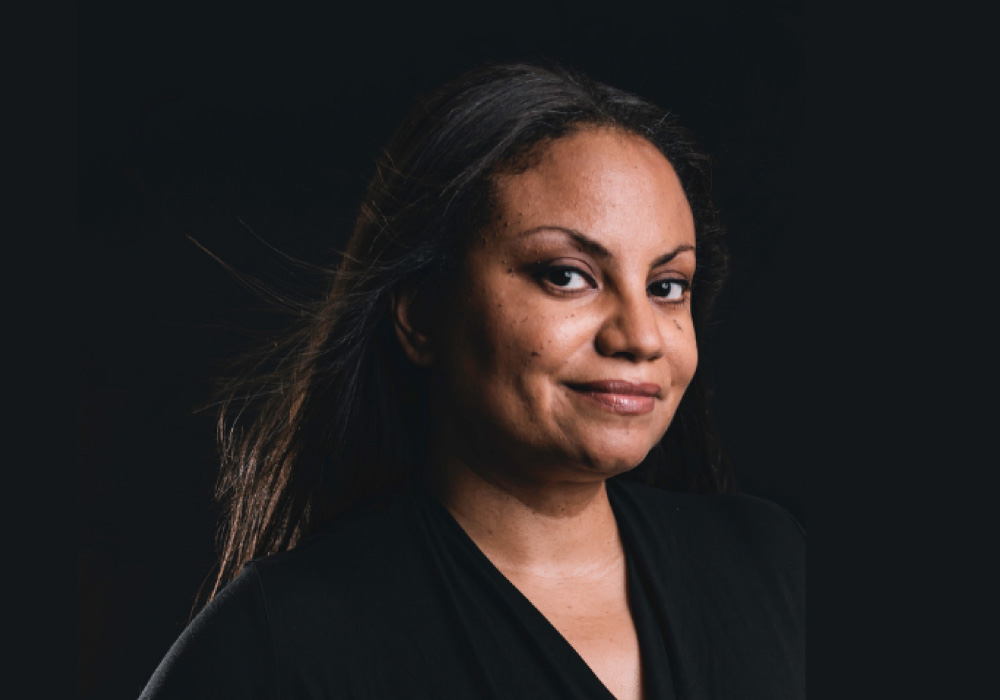
Timea Wharton-Suri has spent more than three decades navigating professional dance, entrepreneurship, arts administration and cultural leadership. From performing with Ballet Creole and Ronald Taylor Dance to running her own dance fitness studio and earning an MBA from the Schulich School of Business, her career has been shaped by an unusual ability to move between artistic practice and business. Now, as Executive Director of dance Immersion, she is helping build the infrastructure artists need while preparing for the inaugural Immersion Festival in Toronto.
Timea Wharton-Suri started dancing as a young child, copying moves from MuchMusic videos and even appearing once on Electric Circus. But it was a performance by Ballet Creole during her high school years that made her seriously consider dance as a career.
That decision set her on a path from York University's dance program to professional stages, from running her own dance fitness studio to earning an MBA from the Schulich School of Business, and ultimately to the leadership of dance Immersion, the Toronto-based organization dedicated to presenting and supporting dances of the African diaspora.
In this episode, Wharton-Suri talks about the realities of building a life in dance, the business skills artists need, the gaps that remain in Canada's dance infrastructure and the thinking behind dance Immersion's inaugural Immersion Festival.
At the centre of the conversation is a question that extends well beyond dance: what does it take to build an artistic ecosystem strong enough to support the people creating the work?
Conversation highlights
Wharton-Suri discusses:
- Her journey from childhood dance enthusiast to professional performer and arts leader
- Combining dance with entrepreneurship and business education
- What a decade of professional performance taught her about the creative process
- The infrastructure and career challenges facing artists of the African diaspora
- dance Immersion's evolution from presenting performances to supporting artists through education, incubation and professional development
- The creation of the inaugural Immersion Festival
- The diversity of African diasporic dance and the importance of understanding its cultural roots
- Her curatorial approach to traditional, contemporary and street dance
- The importance of presenters, representation and spaces where Black artists feel seen
- Her vision for the future of the Immersion Festival and her own continuing artistic practice
Topics covered
- Building a career in professional dance
- Entrepreneurship and dance education
- Running a dance fitness studio
- Earning an MBA from the Schulich School of Business
- Ballet Creole and Ronald Taylor Dance
- The realities of full-time professional dance
- Infrastructure for African diasporic dance in Canada
- dance Immersion's history and mandate
- Presentation, education and artist incubation
- Professional development for emerging dancers
- The Thrive program
- The inaugural Immersion Festival
- Black-led youth dance organizations
- Canadian Black dance artists and companies
- The diversity of African diasporic dance
- Cultural roots and artistic ownership
- Traditional, contemporary and street dance
- Curatorial philosophy
- Representation and belonging
- The role of presenters in the arts ecosystem
- Dance careers beyond performing
- Independent artistic practice
- The future of the Immersion Festival
Notable quotes
Building a career in dance
“It still is a viable career path.” [00:06:56]
“It’s still about carving your own path, but you can have a dance career for sure.” [00:08:11]
The work behind the performance
“My favorite part is the creative process of building the work. Performance is nice, but it’s almost like the cherry on top of the cake.” [00:10:49]
The infrastructure artists need
“We need more presenters.” [00:36:51]
“It’s that much work and it takes you away from the art.” [00:36:51]
The diversity of Black dance
“These are hundreds and hundreds of dance forms and styles.” [00:20:45]
Knowing the roots
“We’re showing really with the conscious—consciously showing folks like artists who are deeply connected to the root, to the Black roots of the thing, whatever it is they’re doing.” [00:23:40]
Moving beyond artistic categories
“My curatorial philosophy does really sort of erase these barriers, these artificial barriers between, well, this is traditional dance, this is contemporary.” [00:26:45]
“It’s that they have a root, a strong root somewhere, and then have developed their work from there. That’s the strongest work.” [00:29:12]
Creating space for artists
“We see you, even if others don’t.” [00:43:47]
Continuing to make art
“Even if it takes you a long time, it’s the working on it that helps your spirit keep growing.” [00:44:39]
When dance and business meet
One of the most interesting aspects of Wharton-Suri's story is the way her artistic and business careers developed alongside one another.
Her family wanted her to have a practical career, so she pursued business education while continuing to build her life in dance. Rather than abandoning one path for the other, she eventually found ways to make them work together.
Running her own dance fitness studio for approximately seven years became an important bridge between the two worlds. She had to make artistic decisions about programming while also dealing with the practical demands of running a business.
That experience now informs her work at dance Immersion.
Although she describes her current position as a combined artistic and administrative role, much of her work involves accounting, bookkeeping, grant writing, partnership development and negotiation.
The artistic side remains essential. As curator, she works with artists, develops programs and shapes presentations.
Her career demonstrates something often overlooked in conversations about arts careers: artistic success also depends on knowing how to build the structures that allow the art to exist.
What professional dance taught her
Wharton-Suri spent approximately a decade dancing full-time with companies including Ronald Taylor Dance, formerly Canvalet Dance Theater, and Ballet Creole.
That period taught her that professional dance requires far more than technical ability.
She learned what it means to work with choreographers, dramaturgs, musical directors and production teams, and how many people are required to transform an idea into a finished stage work.
That experience now informs the way she thinks about the support artists need.
It also shaped her belief that the performance itself is only one part of a much longer creative process.
dance Immersion was created to put Black dance on stage
dance Immersion was founded in 1994 by dancer Vivine Scarlett, who wanted to create greater opportunities for African diasporic dance on Canadian stages.
Wharton-Suri describes systemic racism and longstanding assumptions about Black arts as part of the environment that made the organization's work necessary.
dance Immersion's primary role remains presenting dance and creating opportunities for audiences to encounter work on stage.
But the organization has expanded considerably.
Its work now spans presentation, incubation and education, with programs that include workshops, professional development, artist development and mentorship.
Its Thrive program provides emerging artists with practical guidance around building a dance career, the business of dance, self-care, collaboration and developing new work.
The evolution reflects a broader understanding of what artists need.
Getting a work onto a stage is one thing. Building the skills, relationships and infrastructure required to create that work is another.
Why the Immersion Festival matters
The first Immersion Festival grew out of a 2024 national showcase.
After the showcase and accompanying workshops, audiences, dancers and presenters began telling dance Immersion that the event already felt like a festival.
The response prompted a bigger question: why not actually create one?
The answer was not simple. Production costs are rising while financial support does not necessarily rise at the same rate.
But Wharton-Suri sees a particular need for a festival that invests in Canadian Black artists.
The inaugural Immersion Festival runs November 8–22, 2026, with performances and workshops centred at the Betty Oliphant Theatre, 404 Jarvis Street, Toronto. Additional festival gatherings take place at nearby Jarvis Mansion.
The festival brings together three stage presentations, 12 workshops, an intergenerational dance education roundtable, an artist-presenter networking lunch and a closing celebration.
Immersion Festival 2026: full schedule, tickets and festival information
Three stages of a dance career
The festival's three principal presentations create a progression through different stages of artistic development.
Next Gen takes place November 14 at 7:30 p.m. and November 15 at 2 p.m. It features 10 performances by Black-led youth groups, with artists representing Caribbean, West African, hip-hop, ballet and street dance traditions.
National takes place November 20 at 7:30 p.m. and November 21 at 2 p.m. It brings six Canadian Black-led dance companies and artists from Calgary, Toronto, Montréal and Nova Scotia to the stage. The program spans West African, hip-hop, contemporary, Caribbean jazz, waacking, Cameroonian and contemporary African dance.
Vanguard takes place November 21 at 7:30 p.m. and November 22 at 2 p.m. The presentation features seven commissioned dance and live-music duets involving internationally renowned Canadian dance artists and musicians.
Alongside the performances are 12 workshops for youth, beginners and professional dancers. The workshop program includes African Street Dance Fundamentals, Bahamian Caribbean Folk, Vernacular Jazz and Rwandan Traditional and Contemporary Dances.
The festival's additional programming includes a free intergenerational dance education roundtable on November 9, an artist-presenter networking lunch on November 19 and a closing celebration on November 22.
Taken together, the programs create a continuum from young dancers beginning their journeys to established artists presenting work at an international level.
There is no single Black dance
One of the strongest themes in the conversation is the sheer breadth of African diasporic dance.
The festival brings together artists working across West African dance, hip-hop, contemporary, Caribbean forms, jazz, tap, Krump and other styles.
Wharton-Suri pushes back against the tendency to treat Black dance as a single artistic category.
“These are hundreds and hundreds of dance forms and styles.” [00:20:45]
For her, that diversity is something the festival needs to make visible, particularly to young people.
Representation is not simply about seeing a Black person on stage. It is also about seeing the breadth of what Black artists can create.
Know where the movement comes from
The conversation also addresses the complicated relationship between cultural roots, artistic evolution and ownership.
Wharton-Suri says dance Immersion consciously works with artists who have strong connections to the Black roots of the forms they practise.
That does not mean the work has to look traditional.
An artist can create contemporary or commercial work while remaining connected to the history and cultural foundations from which that work developed.
dance Immersion's Legacy Series similarly explores the Black and African roots of different dance forms, helping audiences and artists understand histories that can become obscured as forms move across cultures and generations.
For Wharton-Suri, the strongest artists understand their roots and then develop their own artistic language from there.
Breaking down the traditional and contemporary divide
Wharton-Suri's curatorial philosophy challenges the hierarchy that can place certain dance forms above others.
She rejects the idea that traditional dance belongs in one category while contemporary dance represents something inherently more current or sophisticated.
Street dance, for example, is continually evolving.
Traditional forms can also become the foundation for new contemporary work.
What matters to Wharton-Suri is not the label attached to the work, but whether the artist has a strong foundation and understands where their artistic language comes from.
“My curatorial philosophy does really sort of erase these barriers, these artificial barriers between, well, this is traditional dance, this is contemporary.” [00:26:45]
And, as she puts it:
“It’s that they have a root, a strong root somewhere, and then have developed their work from there. That’s the strongest work.” [00:29:12]
The presenter as part of the creative infrastructure
Wharton-Suri's experience at the Toronto Arts Council gave her an opportunity to look at the arts sector from a broader perspective.
She came to recognize that many of the challenges facing dance artists are not unique to dance.
Presenters play a critical role because they connect artists with audiences while also taking responsibility for the practical work surrounding a performance.
Without that infrastructure, artists can end up spending enormous amounts of time handling marketing, production, venues, administration and other tasks themselves.
As Wharton-Suri says:
“We need more presenters.” [00:36:51]
And:
“It’s that much work and it takes you away from the art.” [00:36:51]
She also points out that dance careers can extend into many roles that audiences rarely associate with the art form: lighting design, stage management, production management, costume design, carpentry and set design, projection and media technology.
The skills developed in dance can travel much further than the stage.
Making room for artists who have felt unseen
Representation becomes especially meaningful when artists enter spaces where they may historically have been the only Black person in the room.
Wharton-Suri has worked with institutions including the National Ballet of Canada, where she served as a choreographic advisor for a company dancers' choreographic workshop.
She sees signs that traditionally less accessible spaces are opening up.
But dance Immersion's mandate remains important because it creates an environment where African diasporic dancers do not have to explain why their presence matters.
The festival brings together artists from ballet, tap, contemporary African dance, Krump and other forms.
For Wharton-Suri, the message to those artists is simple:
“We see you, even if others don’t.” [00:43:47]
The artist behind the arts leader
There is another dimension to Wharton-Suri's story that emerges late in the conversation.
While much of her professional life is now devoted to helping other artists develop their work, she is still trying to maintain her own artistic practice.
She is working on an independent dance film that evolved over several years through poetry, photography, filming and ideas developed whenever she could find the time.
The film has not yet been presented because she wants to do it properly.
Her experience is a reminder that even arts leaders who spend their careers creating opportunities for others still need space to create themselves.
Her approach is patient:
“Even if it takes you a long time, it’s the working on it that helps your spirit keep growing.” [00:44:39]
The festival she wants to build
Wharton-Suri is already thinking beyond the inaugural festival.
Her goal is to make Immersion Festival a biennial event, something audiences anticipate and artists actively want to be part of.
She imagines families attending together, audiences returning for workshops and performances, and the festival becoming a recurring gathering point for Toronto's dance community.
She also wants artists to aspire to the festival.
The three program levels give audiences opportunities to encounter different stages of a dance career, from youth through professional development to established artistic practice.
As she explains:
“We want for it to be such a meaningful experience, but also showing our excellence at these 3 different levels and say, you can all see yourselves here in one of these, these 3 presentations.” [00:46:48]
That ambition captures something larger than the launch of a new festival. It is an attempt to create a permanent piece of cultural infrastructure.
About Timea Wharton-Suri
Timea Wharton-Suri is Executive Director of dance Immersion, where she combines artistic curation with organizational leadership.
Her career spans more than three decades in Canadian dance. She trained at York University, performed professionally with Ronald Taylor Dance and Ballet Creole, operated her own dance fitness studio for approximately seven years and earned an MBA from the Schulich School of Business.
Her work has taken her through performance, education, entrepreneurship, arts administration, curation and advocacy.
About dance Immersion
Founded in 1994 by dancer Vivine Scarlett, dance Immersion is a presenting organization connecting artists, communities and audiences through African diasporic dance.
Its programming is organized around three interconnected platforms: presentation, incubation and education, alongside its Legacy Series and youth mentorship work.
The organization's current season places the Immersion Festival at the centre of its 2026–27 programming, alongside workshops, a mini Krump festival and its Legacy Series.
Festival information
Immersion Festival 2026
November 8–22, 2026
Betty Oliphant Theatre
404 Jarvis Street, Toronto
Roundtable, artist-presenter lunch and closing celebration: Jarvis Mansion, 504 Jarvis Street, Toronto.
The official festival page includes the complete schedule, performance information, workshop details, ticket pricing and registration information.
Visit the official Immersion Festival website: https://danceimmersion.ca/immersionfestival/
For festival questions and ticketing, dance Immersion can be reached at