
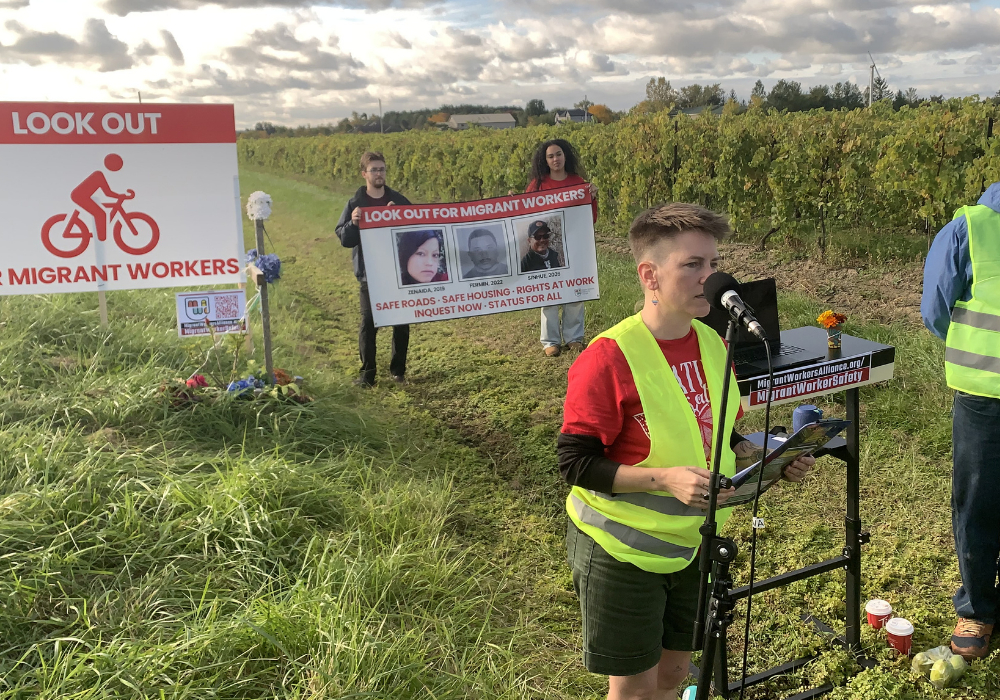
Giant reflective signs now mark five Niagara roadsides where seven migrant farm workers were killed or seriously injured since 2019. Installed by the Migrant Workers Alliance for Change as the Seasonal Agricultural Worker Program turns 60, the signs carry a direct message to drivers and a broader one to every level of government, asking for safer roads, decent housing, full labour protections and permanent status.
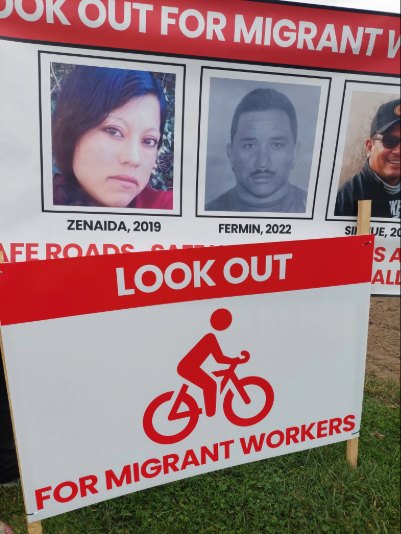
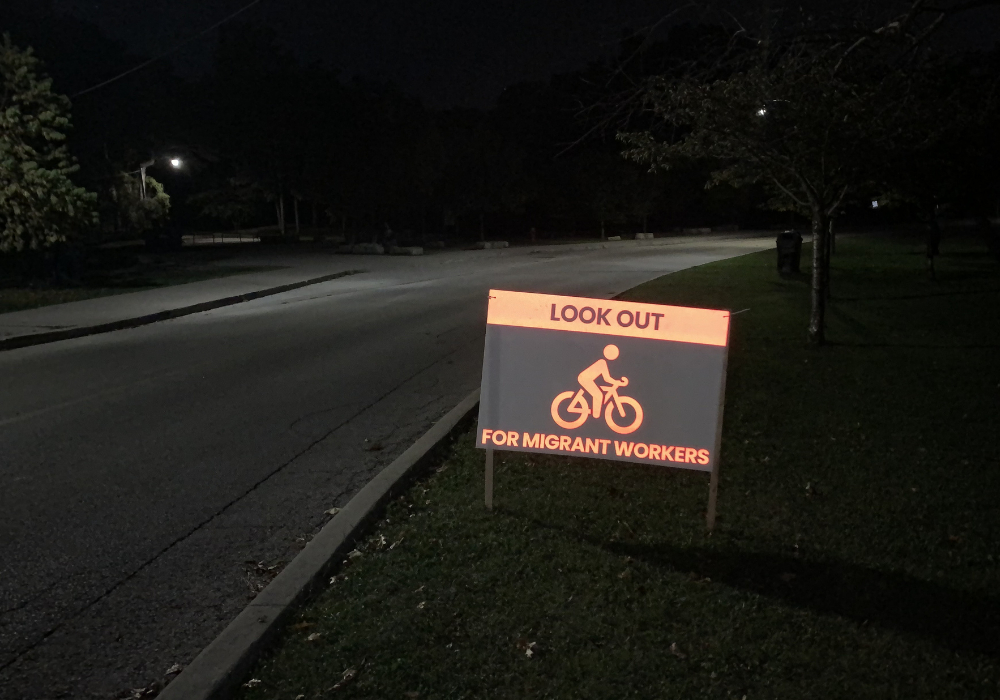
Giant reflective signs now stand at five roadside locations across the Niagara Region, each one placed where a migrant farm worker was killed or seriously injured. They read “LOOK OUT FOR MIGRANT WORKERS” in lettering built to flare bright when car headlights sweep across it. Seven workers are connected to these sites. Three of them did not survive.
The Migrant Workers Alliance for Change began installing the signs on October 14 on Concession 6 in Niagara-on-the-Lake, where 39-year-old Sinhue Garcia was struck and killed while cycling home in June. Additional signs are going up outside municipal offices in Niagara-on-the-Lake, St. Catharines and Lincoln, placing the message at the doors of the councils that manage these roads.
The timing carries weight on two fronts. Canada’s Seasonal Agricultural Worker Program turns 60 this year, a partnership that began with Jamaican workers in 1966 and has been celebrated with ceremonies, scholarships and a night of black, green and gold light over Niagara Falls. Ontario voters also head to the polls on Monday, October 26 for the municipal elections. Workers and organizers are using both moments to argue that six decades of reliance on migrant labour has yet to deliver safe roads, decent housing or the security of permanent status for the people doing the work.
Five roadsides, seven workers
The signs mark crashes spanning 2019 to 2026, in rural Niagara-on-the-Lake and urban St. Catharines alike. Several were hit-and-runs. Read together, they trace a pattern organizers have been describing for years, with workers on bicycles or on foot, often after dark, sharing narrow roads with fast-moving traffic.
| Location | Worker(s) | What happened |
|---|---|---|
| Concession 6 between Line 4 and Line 5 roads, Niagara-on-the-Lake | Sinhue Garcia, 39 | Killed while cycling home, June 2026 |
| Concession 7 near Line 6, Niagara-on-the-Lake | Zenaida, 33 | Killed in a hit-and-run while walking, 2019 |
| Lakeshore Road and Townline Road, Niagara-on-the-Lake | Omar | Seriously injured in a hit-and-run while cycling, 2023 |
| Carlton Street and Dorchester Boulevard, St. Catharines | Ceto Reid | Seriously injured cycling home from a laundromat, 2022 |
| Seventh Street Louth, St. Catharines | Fermin Soto Sanchez, Alfonzo and Francisco | Soto Sanchez killed and two co-workers seriously injured, 2022 |
Garcia’s death is the most recent. Niagara Regional Police were called to Concession 6 near Line 4 Road shortly before midnight on Friday, June 26, and he died at the scene. A husband and father of two from Mexico, he worked at a large hydroponic greenhouse operation nearby. A 22-year-old Niagara-on-the-Lake man was arrested hours later and charged with impaired operation causing death and failing to stop after an accident. Those charges have not been proven in court.
How an ordinary errand turns dangerous
The reasons workers end up on these roads are structural. Most migrant farm workers live in employer-controlled housing far from town centres, and public transit in rural Niagara is thin. A trip to buy groceries, send money home, see a doctor or visit friends usually happens by bicycle or on foot, frequently after long shifts that stretch into the evening.
The alliance identifies several conditions that compound one another:
- Long, unpredictable hours that push personal errands into the dark
- Employer-tied work permits that make changing jobs difficult
- Gaps in provincial labour law, with Ontario farm employees exempt from Employment Standards Act rules on overtime and hours of work and farm workers kept outside the Labour Relations Act
- Rural roads with fast traffic, weak lighting and few safe shoulders or crossings
- The risk of losing the right to work and remain in Canada after speaking up
Ceto Reid knows those risks firsthand. The Jamaican farmworker had been coming to Canada for nearly two decades when he was seriously injured in 2022 while cycling home from a laundromat almost eight kilometres away. Speaking by video call on the day of the installations, he placed responsibility with the people who set policy.
“We are the ones feeding the people, so look out for us,” Reid said. “We have to use the roads, we have to live here, we have to work here. Look out for us. We are here.”
A program built on Jamaican labour turns 60
The Seasonal Agricultural Worker Program started in 1966, when 264 Jamaican workers arrived in Ontario to help bring in the apple harvest. It now brings more than 30,000 seasonal workers to Canada each year from Jamaica, Mexico, Trinidad and Tobago, Barbados and the Eastern Caribbean. Jamaica alone sends more than 9,000 workers annually.
Jamaica’s government has marked the anniversary with real ceremony. Niagara Falls glowed in the national colours on April 25, and a scholarship program now supports the children of Jamaican farmworkers. Long-serving workers and “day one” employers have received awards at events across Ontario.
Kit Andres, the alliance’s Niagara-based organizer, ties that history directly to the roadside signs. “Our migrant worker neighbours have been coming here for 60 years, growing the food that makes this region what it is,” Andres said. “But they’re still being killed and injured just trying to get home.”
Syed Hussan, the alliance’s co-executive director, frames the anniversary as a deadline long since passed. “Governments have had 60 years to act,” he said. “How many more workers must be killed or injured before they do?”
What workers are asking each level of government
The demands are specific and spread across every tier of government, reflecting the alliance’s view that roads, housing, labour law and immigration status work together to shape a worker’s safety. Hussan described them as “policies that work together to deny them the freedom to make decisions about their own lives.”
| Level of government | Workers’ demands |
|---|---|
| Niagara-on-the-Lake, St. Catharines and Lincoln councils | Safer shoulders, better lighting and crossings, starting with routes identified by farmworkers |
| Niagara Region | A worker-led road safety audit with public progress reports, plus proactive inspection of migrant worker housing |
| Province of Ontario | A coroner’s inquest into farmworker road deaths and injuries, stronger housing standards and full inclusion in provincial labour law |
| Government of Canada | Permanent immigration status for all migrant workers |
A municipal vote lands Monday
Niagara residents elect their councils on October 26, and the alliance has turned road safety into a campaign issue. As of mid-October, 36 of 63 Niagara candidates had signed its Migrant Worker Safety pledge, according to the organization. In Niagara-on-the-Lake, internet voting remains open until 8 p.m. on Sunday, October 25, with in-person polls open on election day.
The municipality of Niagara-on-the-Lake said in July that it continues to prioritize initiatives that improve safety. The signs suggest workers intend to measure that commitment against shoulders, streetlights and crosswalks they can actually use.
What the headlights reveal
The signs were designed to work at night, the hours when migrant workers are most often on the road and least often seen. That choice captures the campaign’s central argument. These workers are a permanent fixture of Niagara’s economy, returning season after season for 60 years, yet the infrastructure and laws around them still treat their presence as temporary.
Whether that changes depends on decisions made in council chambers, at Queen’s Park and in Ottawa. Monday’s vote offers the first test. Reid’s request to drivers and decision-makers alike was simple, and it is now printed in reflective letters along five Niagara roadsides for anyone passing through to read.